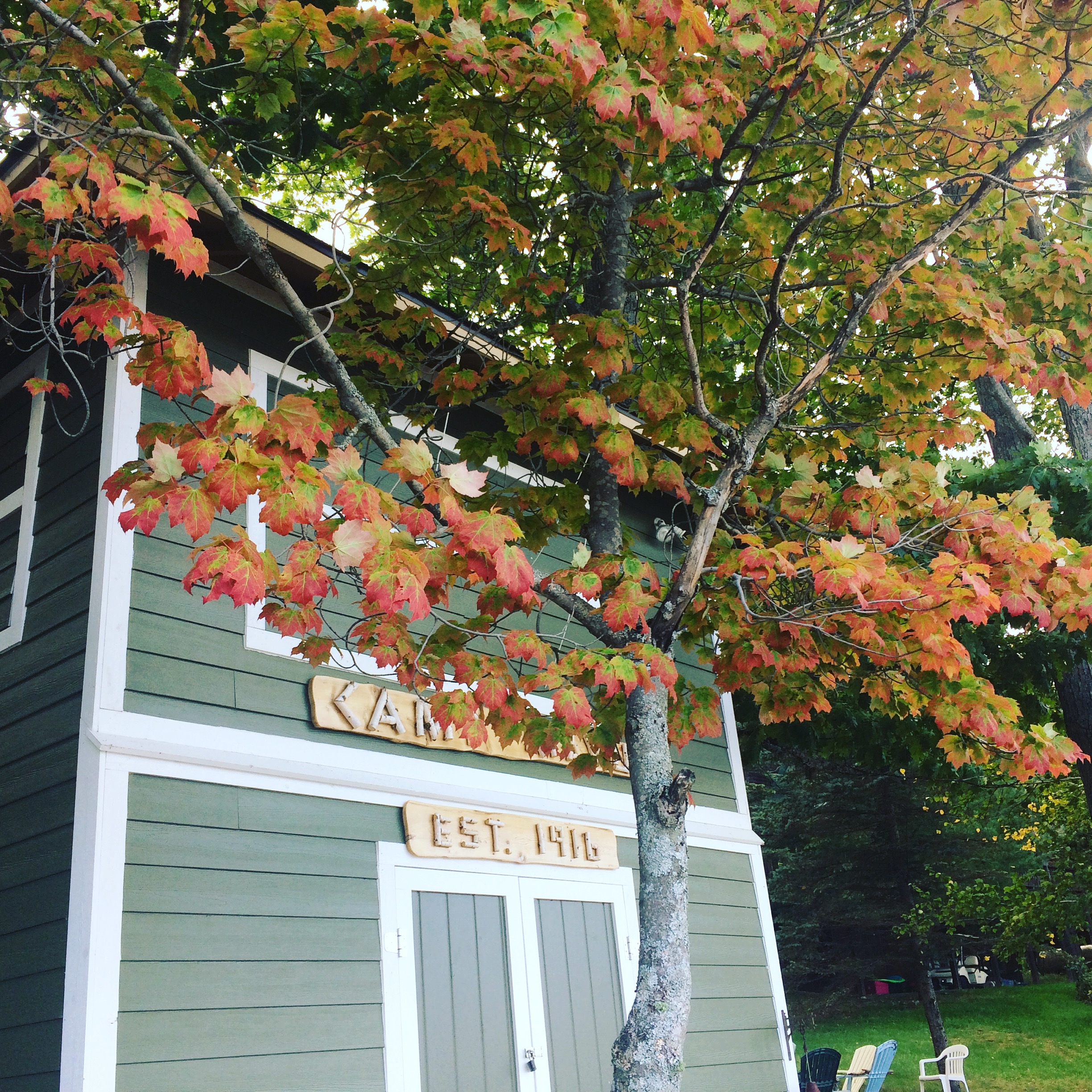
Camp Envy-Bunk Houses and Outbuildings

Those musty wooden huts had to be a little frightening for little girls who had never left their homes. Bunking in with seven others, sometimes all strangers and accompanied by mosquitoes and spiders, had to leave lasting memories. Many of those little bunkhouses are still standing, but a few were removed from the property before the subdivision was developed by the previous owner. They are scattered around Hale as outbuildings for whoever purchased them.

Our hut was number one next to the lodge. It has been since transformed into a cozy little guest house that sleeps five. The original wood floors gleam golden honey and the walls are painted white. (Had I known how sentimental ex-campers and staffers were about their names on the wall, I would have preserved at least one wall.) The windows with the pull ropes and damaged screens were replaced with vintage sash windows from the same era, and they let the breezes blow through on hot and humid summer days. A ceiling fan was installed and window shades for privacy, but the porch screen door still slams shut and the original wooden front door remains.

The Brownie at the dip in the hill by the trail to the lake still stands. It is constantly used, as it still contains a portable shower on one side with the boy’s commode and a girl’s commode on the other with sinks on both sides. It is convenient to the lake and kept up in repair and cleanliness for our family and guests.

Further up the trail, another hut tilts at an angle that is precariously dangerous when the skewed door is opened. The names are still plastered in lipstick and toothpaste and the floors are rotting. There are plans to take it down and I have asked for boards with names I recognize from interviewing campers when that day happens. Housed in there for years was a cubby that graced one of the huts and it was gifted to me. On the same property, the owners preserved the hut that stood tall and proud by the lake as their own bunkhouse before building their log cabin. The names still remain on their walls and the sliding glass door at the front gives a great view of Loon Lake.

On the property where the senior Brownie stood is a magnificent log home with a garage attached. It was the senior Brownie, transformed by turning the roof around and installing a garage door. This family also owns one of the huts that was utilized for years as their weekend cabin until they built their home. They also moved the cook’s cabin to their property, high on a hill where “Scold Trail” is used for their cross country skiing in the winter.

The last two huts face the lake by the boathouse. One was moved off the property next to the firepit to make room for a log cabin for the family and sits behind the craft hut and used for storage of lake toys. The other hut has had a renovation, complete with a bathroom, deck, new windows and siding painted to match the owner’s house, which was the cabin by the fence. Their grandchildren have full use for sleeping and activities and the renovations from the lake make the property appear like a resort or a family compound, which it is!

Along with the lodge, the campcraft (left) hut on the front lawn and the boathouse and craft hut still stand and are in great shape, since the historical committee of our association sets aside funds to keep up with repairs and renovations. Every building that survived is utilized and treasured as a piece of history from the camp and enjoyed by our family and friends. The craft hut and boathouse, especially hut nine above, has had floors repaired and exteriors shored up and painted and are in constant use with residents for their reunions and overflow company.

Gone is the gazebo, which was consumed by age, the elements and the chipmunks. The infirmary is now a part of a guest house, and the trading post (or camp store) did not withstand the test of time. Dutton stood for years, but from the very beginning, repairs were constant. It was taken down to make room for a family cabin and they saved the doors covered in graffiti.  There are photos and memories and traces of what was—including the concrete of the tennis courts, the campfire pit area and horse trails that serve as hiking trails.


Camp Extension As Adults–

Sheryl Beisman left bottom row, (1973-78) still has a family lake house on Lake Lobdell in Fenton, which was a huge part of her life and a natural extension of camp. Marsha Garber still owns a place on a lake in Glen Arbor, and developed a love for campfires and singing at camp in 1964. Pam Wintermute only attended two summers in 1955 and 1956 because her family owned a cottage on the Tittabawassee River. Minette Jacques(1955-57) still loves to go barefoot at her home on Mullet Lake. Marcia Michelson (1963-70)  loves to visit her in-law’s summer home in Maine. “I just sit there and read a book and just the land around there reminds me of Maqua.”

“I always liked the outdoors and camp was a wonderful experience for me. I always felt sorry for the ones who were there all summer, thinking maybe they got dumped off by their parents, but on the other hand I was envious that they got to be up there all summer. We own a cottage up north on Intermediate Lake near Shanty Creek and I still walk, swim, boat and we water and snow ski as a family. I sent my daughter to Girl Scout camp and she hated it and was homesick, but my son went to Indian Guide camp and loved it, “ said Beverley Schlatter, who said Maqua made her more of a leader in the forties.

“At school, I was on the student council, was the editor of the yearbook and co-chaired the prom. I don’t think I would have done that without the leadership and training that headed me in that direction. I think the counselors pushed me forward. Camp Maqua was the groundwork. I majored in retail at college and did not work long in my field, but worked for the telephone company, the Michigan School for the Blind, had my family and ended up in the insurance industry.”

“We have a cabin in Tawas with a stone fireplace,” said Muriel Richert, who only camped one summer in the fifties. “It must have been tucked back into my subconscious somewhere in those Camp Maqua days that the fireplace was wonderful since the memories are remembrances,” said Muriel, who just retired from thirty-four years of teaching the same age child as the year she camped.

As a WMU grad in physical education, Tricia Sautter (1968-70) still remains active today and said exercise is still very important to her. After getting her Masters, she transferred her love of people into gerontology with a career in the Department of Aging, where she works with programming and activities for Jackson County. Her love for the outdoors stayed with her while she raised her family of four on a renovated farm and still has a cabin in the Michigan woods.

“I think camp taught me to get along with people and I also really learned to make square corners on my bed. Like the Army,” laughed Margot Homburger (1946-1952). “And no dust bunnies in our cabins. The cabins had to be spotless every day. I was shy as a child, but I loved being at camp. I didn’t learn any particular skill, but when I look back the skills were everyday skills and they left a mark.  I loved camp and my brothers did not. I never had a problem going off to school after being at camp.”

She later became a counselor at a private co-ed camp, which she felt was not as strict. Her continuation of camp happened when she and her husband bought property on Walloon Lake in the early seventies. “It is the closest thing to Maqua. We go up every New Year and in the fall. I loved all those years at Maqua.”


Camp Influenced Many Lifestyles–

Many of the girls who camped at Maqua already had  family cabins on lakes, rivers or in the woods. For those who did not, many later in life chose that summer or winter cabin lifestyle, which was reminiscent of their early years at camp in the fifties. It was a wonderful way to grow up and they shared that experience with their families and friends.

“I feel like camp had multiple impacts on me. When I heard my Dad talk about the CCC (Civilian Conservation Corps.) under Roosevelt, where people went to camps to plant trees and built bridges, I think of how it put people to work with a minimum wage and it was a coming together to do good things, “ said Caryl Sue Abendroth, who camped in the fifties.

“I compared my experiences of his to Maqua. I learned to experience and create and it nurtured my spirit .We need more of the gentle camp experiences today where children are encouraged to sit in quiet, read, walk and write. Instead of the viciousness I see now, we helped and cooperated. Camp pulled people together and we could just be one for awhile.”

“My father bought a cottage on Loon Lake and it was a long walk from the camp. It was the greatest little cottage and it was to the right of the camp. I went to camp before they had the cottage, but I do believe they only had that cottage for two summers and had to sell, since it was too expensive to keep up two homes.  I think I was thirteen as a camper and fourteen as a C.I.T. and I am seventy now and I have this longing to own a place back on Loon Lake.”

Caryl Sue has been involved with and created programs for schools for gifted and talented children and continues her leadership in her community. Her background is in education and writing.

“I know I was always on the outside looking in, but in general I loved going to camp,” said Gretchen Jacques, who camped in the fifties.  “I couldn’t relate to the homesick girls. I loved the woods. My Mom would never camp and so maybe that is why it was so great for me. I got to be out. Sleeping outside. And when I got older, I tent camped. It was a chance for me to have an outdoor experience day after day at camp, even when it was raining. (I learned to play poker on those rainy days.)”

“We used to rent places on Mullet Lake when we were growing up and now my two sisters have places on Mullet Lake, and I think maybe I should buy a little piece of land and then I think—no—I don’t want to do Michigan winters. But, when we get together, we have so much fun! As a kid, I hated to leave those places, too. My whole family felt like that, too. I loved it and hated to leave, just like camp. I call it “Reverse Homesick”.

Sally Harris(1950) experienced camping in the late forties and fifties.She was a pre-school teacher, married young and had a boy and a girl. Her husband was from Charlevoix, so they had a cabin up there and her daughter went to Camp Daggett. Her son didn’t go, but she and her husband enjoyed camping all over the country.

Barb Hale (1950) recalled,“My sister and I coaxed and coaxed to go to camp and we had experience with camping with our parents, who loved to vacation with tents and a trailer. Our cabin, which was built in 1945 is still standing near Cooke Dam Rd. and our family still goes up there. When we were young, there was no electricity and we used kerosene lamps. My parents would go up every two weeks during deer season and we would get our two weeks of homework and did our lessons faithfully and it was so much fun! My daughter even wrote a book about the cabin.”

“When I look back at my camping times, I can still smell that cabin smell at Camp Maqua and I liked the odor. I loved the lodge on the hill and it seemed so big at the time, but when I drove back for a look years later it looked so much smaller as an adult.”


Camp’s Influential Memories–

Long after the young girls left camp, the smells of the lodge and cabins, the fresh smell of the piney woods, the sound of the Loons and the lap of the waves on the lake left an indelible mark in their minds. So much so that the great outdoors called to them in many ways.

Judy Sherman felt like camp was all about enjoying the outdoors and it still gives her good memories to this day, even though she camped in the forties.  Sixties camper/ staffer Karen Magidisohn continues to camp and kayak to this day.

Nurse Kathleen Clements said, “I learned to love the outdoors and it rounded me out. I had experiences I would never have had and I still love to fish and be on the water. If given the chance, I head to a lake before I will go anywhere else. I have such a respect for nature, animals and the environment. I had to watch out for critters at camp.  I would rather be outside than anywhere and I have this thing for animals and wolves—maybe because I heard wolves howling at camp.”

“I first went to Camp Maqua in 1925 as an almost-thirteen-year-old for two weeks, and I went back for five consecutive years—mostly for two weeks”, wrote Harriet Crumb. “The one year I hired out as a Kitchen Aid when my two weeks was up and stayed for two more. You can see how I loved it. In 1929 I went for one week—to take and pass the tests for my American Red Cross Life Saving Badge. I was a big girl then, of course, and the next summer when I couldn’t go at all, I thought the world had come to an end. Other girls seem to be able to take or leave it, but from the first, I was hooked and in some form have enjoyed camping ever since.”

“I ended up at MSU with a degree in Environmental Science and then my master’s degree and at thirty-one, I got my law degree and practiced family law with spousal, domestic and child abuse. I think the thing that helped me with the diversity of people in my profession was the caring and acceptance I found at Maqua, “ said Chris Lambert. “That stayed with me for the rest of my life. I was in legal aid for a while and I wanted to reach out to people. Camp helped me to become more responsible and my college years were wilder, with my active part in the Vietnam War demonstrations and a trip to the big gay pride demonstration in Washington in the sixties, but my job as a sports director helped me with organization, because I had a responsibility for an area and I found I liked it. My father was an attorney and my parents were affirming and encouraged me to become the person I was meant to be, but Maqua brought me friendships and closeness and those close relationships at camp, which followed into college when I roomed with many Maqua girls, was tremendously important.”

“Maqua was a loving cocoon,” ended Chris. “It was a spiritual, warm and loving place. The best I could hope for would be the preservation of that spirit. To this day my partner and I still love outdoor activities. My parent’s idea of camping was a room at the Holiday Inn, but I have taken survival classes, hiked the Appalachian Trail, camp, kayak, still love to canoe and have hiked in the Colorado Mountains for two weeks. I owe the start of all this to my activities at Maqua, which contributed to my love for the outdoors. I have to admit, I do have a motor home now, so I can have a real bed and bathroom.”

Friendships, the music, campfires and the ceremonies were a large part of Karen Kaiser’s (photo above) memories at camp (1959-62). “It was a chance to become who we were. Karen met her husband at WMU and both were both successful athletes. She went to college on a sports scholarship, but due to an injury on her ACL after a fall, was in danger of losing her scholarship Every year she had to be voted back into the program and sign letter of liability release, so she could stay in the program and compete. Her husband began a camp for underprivileged kids and they became co-directors and now works full time at Van Buren Youth Camp.  She said they both have a long tradition of camping in their family. Karen is the author of many books and is a motivational speaker and is pictured above.

Camp Honed Responsibility–

Confidence, self-esteem, fearlessness, self-sufficient, and nurtured were other common words that campers and staff used to describe their experiences found at Maqua.

Karen Selby, seventies camper and staffer said,” As a camper, I tried everything I could not do in Bay City. I rode a horse. I learned how to shoot a bow and arrow. I learned how to orient out of a city and learned things I could not have learned in a city, which allowed me to travel later. I was so thankful for those experiences.”

“One of the best things about camp was it gave me self-respect. I was so timid”, admitted Bonnie Kessler (1947). “ People at camp accepted me and liked me and it was a boost to my ego. It changed me from being so introverted to a confident girl.”

World events did not register with this ten to twelve-year-old in the seventies and if something happened, she was unaware, but felt she only had positive memories of Camp Maqua and especially with that many women in one place! “If there is a story to contribute from my first summer there, it would be that I found my own friends, even with older sister Doris there,” mused Judy Engibous,” and I made my own way and became comfortable with my nerd role.”

The waterfront activities, the exposure to new people and interests, coupled with the mentoring of the older counselors helped Marge Hasty (1946) to develop new confidence. When she graduated from college, she and her sister took off in a convertible and became counselors at a camp in Minnesota for the summer.

“I first realized when I chose education and counseling as a career that Maqua had shaped my life. I actually really could teach, because as a junior counselor I had taught arts and crafts. I taught art in Missouri and loved it. My pathway was figured out at a pretty young age,” admitted Kathy Carney, who camped in the early seventies..

“This was the first place I connected with other women who were strong role models. It was the first place I experienced my power with other confident, intelligent, self-sufficient women who were great mentors and nurtured us as young girls in the sixties”, said Anne Moore, whose career took her down a holistic nutrition path. She is shown in the upper photo on the right with campers Marsha Immerman on left and Pat Purcell in the middle at the lodge on a meet-up.

“I don’t like to say I’m a feminist, but the typical housewife role was out the window during those days. My experiences gave me an understanding of women born around the time fifteen years before when you were the Mom, had babies and didn’t work. Camp helped me to realize women could exist independent of men and did a good job! We had good mentors. It was the first time I ever tied a bowline,” laughed Sally Allen (1968-73).

“I have a strong personality”, admitted Anne Obey, who felt like the atmosphere at camp allowed her to become competent and confident, “but I made great friendships there. I slept and lived camp. Not one day was I ever homesick and it was 100% easier to go to college because of the independence I learned at camp. I grew up socially and emotionally at Camp Maqua(1960-70). It was a camp that honed responsibility, leadership skills, and family values. The commitment I had as a camper and a staffer was a perfect lead into my education career.”

Camp As An Opportunity To Grow–

There were many life-shaping stories from the girls of Camp Maqua, from learning manners, to working as a team, to earning their first paycheck or developing confidence. Others were influenced to go to single-sex colleges based on the close friendships made while at camp.

Amy Johns’ (shown above at a Maqua reunion), (1967-78) constant family moves left her with very little camp memorabilia, but she has a few photos, award ribbons, and memories. “I was the baby of the family and definitely a crybaby and a drama queen. I could turn on the tears and get what I want. But, Camp Maqua made me resilient and independent. It was a safe place to grow up and make friends and get away from the chaos at home. To this day my favorite bird is the Loon.”

As a self-professed people person, Tracy Topping (1962-63) babysat to make money when she was younger and taught special education as a profession. “The kids loved me and I loved them because I was the fun teacher who taught them how to make those lanyards and sing the camp songs.”

“They were the best years of my life. I grew as a person. I took risks in a supportive atmosphere and I developed as a young girl. The counselors were supportive and it came from the top down. It was the first time in my life I worked as a team, cleaning up, trying to pass inspections and even doing dishes together. I felt a part of a valued experience. I learned things I used for the rest of my life and no one was too good to be left out. It was a smorgasbord of opportunities, surrounded by friends, love, and laughter. I will remember Maqua for the rest of my life.”

“I loved having the experience of making my own decisions and learning responsibilities,” said forties camper Mary Jane Keschman. “I learned how to four- corner my bed, and many table manners. To this day, when I have a piece of bread, I remember to break it into four pieces, instead of eating the whole piece as I did at home. It helped my independence to be away and learn to do laundry. When I went away to college, I was all set”, said Mary Jane.“I think about camp a lot. I will meditate to relax and I envision camp memories and create a movie in my head to relax. Camp is still with me.”

“For me, the summers formed friendships which grew and developed, “ said Barb Rehmus, shown on the right of the photo,(1965-76). “I also learned to let go, because it was such a short summer that the girls would gather together and them you knew some would not come back. I also learned a sense of fun. We learned a sense of responsibility having to clean our cabins as campers and later knowing I had to be responsible for kids and classes and to take care of them. It helped develop me as a person, give me new skill sets I would have never learned at home. It also developed my confidence. It helped me enjoy the outdoors, which we still do with our RV.”

“Maqua was a huge part of my life”, said Laurie Cullen who felt like it was the “hey-day” of camping in the sixties and seventies. “My friendships were fabulous, we had so much fun and the mentoring experiences there formulated my decisions for college. It was just a wholesome, happy, fun camp!”

Susan Purdue, known, as “Super-Do”, was her influence to attend college in Colorado, which was a single-sex college. While there, she convinced friends to come back to Michigan to camp at Maqua.“These girls were from Oklahoma, Nebraska, Missouri and all over”, said Sue. “ The balance of women from out of state was disproportionate one of the years I was there. And there was a gay dynamic, a Jewish dynamic—it wasn’t just girls from Bay City. It was the sixties and it was interesting.”